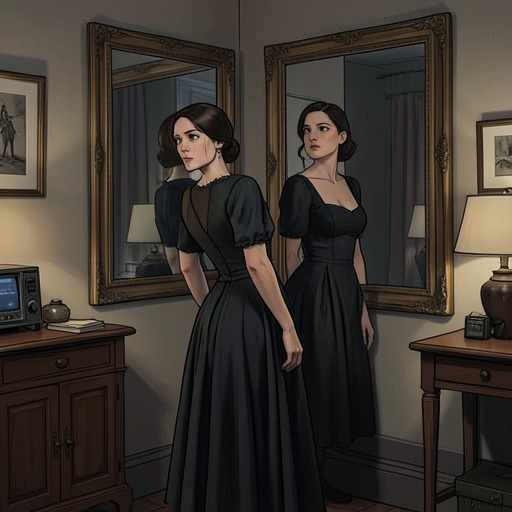
Irene’s concealment of her race from John Bellew
Passing (Nella Larsen Edition)Irene’s concealment of her race from John Bellew at The Morgan tea party is a brief but consequential act of racial passing: in Bellew’s presence, she hides the identity his racist assumptions make dangerous to disclose. Her restraint is not simple agreement or silence. She laughs at first, questions his hostility, and feels anger rising, but chooses composure when she recognizes that exposing herself could put Clare Kendry at risk. The scene makes concealment at once a tactic for protecting another person and an unsettling exposure of the racial order that requires it.
Identity and Context
Irene attends the tea party with Clare and Gertrude Martin, while Clare’s husband, Bellew, remains unaware that the women around him are Black. The contrast between their knowledge and his confidence shapes the encounter: he speaks freely because he assumes that the women share his racial position, while Irene must calculate what she can safely say. Her concealment is therefore situational, but it resembles the racial passing associated with Clare’s life. Nella Larsen’s narrative places Irene, who regards herself as a proponent of race uplift and is repelled by Clare’s passing, in a moment when she too hides her origins from a white man.
The difference between the women’s circumstances remains important. Irene’s concealment occurs within this particular social encounter; the evidence does not make it equivalent to Clare’s sustained passage as white. Yet the episode unsettles any firm opposition Irene might draw between herself and Clare. Irene is intrigued by Clare’s experience, and, when faced with Bellew, performs a related concealment. The scene thus links the two women through action without erasing the different conditions of their lives.
The Tea Party and Its Reversals
Bellew’s racist remarks initially arrive under the cover of joking about Clare’s appearance. Irene joins the laughter, continuing even after the others have stopped, until she catches sight of Clare and recognizes the need for caution. That abrupt change gives the laughter a double meaning: outwardly, Irene appears to share the joke, but her response is constrained by her awareness of what Bellew must not discover. Her performance of ease lasts only while it seems useful to Clare.
The tone shifts when Irene asks whether Bellew has ever known any Black people. He answers that he has not and does not expect to, relying instead on what he has read and heard. Irene’s question tests the ignorance beneath his certainty, but it does not reveal her own identity. As his hostility becomes explicit, she has a strong impulse to identify the contradiction of his drinking tea among three Black women. She holds back when she understands that speaking openly could place Clare in danger. Her concealment is consequently not passive throughout: she probes Bellew, registers the injustice, and then withholds the disclosure that would make her the target of his attention.
Restraint and Its Cost
Irene’s anger does not disappear when she decides not to confront Bellew; it is held in check by caution and allegiance to Clare. She answers him in a casual voice and outwardly maintains calm, while her hands shake and she presses her fingertips together to steady them. Those small actions show the effort required to sustain the appearance of ordinary sociability. Her words and manner preserve the conversation’s polite surface even as she privately recognizes the danger beneath it.
That surface is also carefully maintained through a change of subject. Bellew turns to Irene’s life in New York City and asks about her husband’s medical work. Irene replies that Brian Redfield practices in Manhattan and explains why he needs to be near hospitals and clinics. The exchange lets the tea party continue without disclosing her race; its ordinary domestic details sit beside the hostility she has just heard. The scene’s tension depends on that mismatch between civil conversation and the knowledge Irene must keep from Bellew.
Racial and Narrative Significance
The episode belongs to the novel’s broader critique of racial passing and of the social rules that make racial identity consequential. The critical discussion accompanying the novel connects passing to a history in which whiteness carried legal and material privilege, while racial classification enforced the color line. Under such a system, concealing Black identity is not merely a private deception: it reveals how social access and safety depend on what others believe a person to be. Irene’s momentary concealment makes her participation in that system visible even as her conduct is motivated by protecting Clare.
The nearby reference to the Rhinelander case sharpens the legal dimension of the scene. That highly publicized dispute concerned marriage, racial identity, and the power of courts and public scrutiny to determine how a person was classified. In Larsen’s account, the reference underlines the stakes surrounding Clare’s marriage and racial passing; it does not establish that Irene herself faces the same legal predicament. Together, the case and the tea-party encounter expose the distance between appearance, personal knowledge, and socially enforced definitions of race. Irene’s restraint keeps Bellew from discovering the truth during this gathering, but it cannot resolve the larger contradiction the scene displays: she must conceal who she is in order to navigate a conversation in which racism is spoken openly.